



Viaggia locale, vivi responsabile — senza filtri, senza intermediari
Come with us and spend 12 days going back and forth in time from the ancient Wari culture (pre-Inca) to the magnificent Inca culture, through the Spanish colonial times and the modern era as we explore the rich cultural history of Peru. From Lima and Arequipa.

Our staff will meet you at the Jorge Chavez Airport in Lima. You are free to explore the city on your own, or we can arrange a supplementary tour of the city if you tell us in advance. Overnight stay in Lima.
After breakfast, your exploration of Lima begins with the visit to the Huaca Pucllana, the “Place of Ritual Games”, the Wari adobe and clay pyramid built in the 4th century AD. Moving forward in time you will see the Plaza San Martin and the colonial government palace and cathedral. Your excursion ends in the Museo Larco built over a 7th century pre-Columbian structure and exhibiting the finest and most comprehensive Peruvian pre-Columbian gold and silver collection in the world and the renowned erotic pottery collection.
After lunch (included in the price), you will fly to Arequipa where we transfer to your hotel.
Today you must get used to the thinner air at 2,400 meters (7,874 feet). You begin your trail through history in colonial times by slowly walking the narrow cobbled streets to visit La Casa de Moral, a fine example of a colonial villa and the bustling Mercado San Camillo in a building designed by Gustav Eiffel. Try not to buy too many things, but be sure to look for the coca leaves and purple maize from which the Inca brewed their chicha morada (fermented maize).
Lunch at traditional restaurant (included in the price).
Finally, with our local guide you will visit one of the most important religious monuments in Peru: the Santa Catalina Monastery. This city within a city was founded in 1580 to house nuns from the wealthiest Spanish and local families. Enjoy the deep quiet and rich colours; the visit to Santa Catalina Monastery is the highlight of the day.
Please make sure you include an evening visit to the Plaza de Armas (the main square) and enjoy the many bars and fine restaurants in downtown Arequipa.
After breakfast, you start a 4 hour journey to Chivay and Colca Canyon, travelling through Pampa Cañahuas in the Aguada Blanca National Reserve where you will see the rare vicuña, alpaca, altiplano birds and the Arequipa volcano chain: Hualcahualca, Sabancaya, and Ampato (all above 6,000 meters – 19,685 feet). At your arrival in Chivay, you will enjoy a buffet lunch (included in the price) and have the opportunity to taste the delicious local cuisine.
Prepare for a very early breakfast and then on to “Cruz del Condor” (Condor´s Cross) to watch the enormous and majestic condors soar up to and above the canyon as they have done for millennia. The Colca Canyon, at 3,191 meters (10,469 feet) is the second deepest canyon in the world (twice the depth of the Grand Canyon in the U.S.). Lunch in Chivay (included in the price).
As the condors soar up high, you will make your way to Puno and Lake Titicaca, stopping in the Andean communities of Yanque, Achoma, Maca and then Chivay for lunch. Along the road you will observe the stained-green steppes, peculiar rock erosions, snow-covered Chachani, as well as wild vicuña, alpaca, llama and the Andean Flamingos pass by your windows. In the afternoon arrival in Puno, where you will spend the night.
After breakfast you will sail on the vast Lake Titicaca to reach the unique “floating islands”: Uros. These 50 or so floating islands are perpetually built using layers of totora (reeds) that grow in the lake and if you stand too long in one place you will notice you begin to sink into the water! After lunch, there will be a private tour to Sillustani, funerary towers built by the Colla culture for their nobility. The Chullpas have a cylindrical structure and can reach a height of more than 12 meters (38 feet). The belongings of the dead person where buried here to accompany the dead to the next world. Later, return to Puno.
Your day-long ride will seem like minutes as you pass both cultural and natural wonders! Your first stop is Pukara. A town of potters, Pukara, with its pyramid shaped structures, is the cradle of one of the first civilizations in southern Peru (200 BC – 200 AD). Next you will visit the Pukara Lytic Museum. Later in the day, you will arrive at the La Raya mountain pass at 4,310 meters (14,140 feet), the highest point of the journey. Here, you have the chance to get out, breathe the wonderful air, and take some photos of grazing llama and alpaca, admire the broad altiplano horizon and have lunch in Sicuani at a buffet restaurant (included in the price). Next, visit to Raqchi and the “Temple of Wiracocha”, an enormous rectangular two-story roofed structure. You will also admire the 16th/17th century Andahuaylillas, considered to be the “Sistine Chapel of Peru”,with its marvellous frescoes and ceiling features, and in particular the painting entitled “Virgin of the Assumption” attributed to the Cusco School. After a full day of sightseeing, you arrive at the imperial city of Cusco in time to enjoy a free evening!
After breakfast you begin your private guided tour of Cusco and the great Inca sites. You will marvel at the palace of the Inca, “Hatun Cancha Rumi”, in the Quechua language, where you will see the famous “twelve angles stone”, a gigantic block of granite with 12 corners perfectly framed in a famous stone wall. Cultures collide at the Korikancha “Temple of the Sun”, the most important place of worship at the time of the Incas, now the Convent of Santo Domingo built directly on top of the temple ruins.
A short ride from the city takes you to the following Inca cultural sites:
Early in the morning you leave Cusco for the Urubamba valley, “The Sacred Valley of the Incas”. Your private tour begins with a visit to the Awanacancha Living Museum, where you will learn about traditions and customs of the Andean world. Your, next stop will be the Inca Ruins of Pisaq, an important cultural site on top of a hill at the entrance of the valley. The Pisaq market, one of the main arts and crafts markets in Peru where you can watch craftsmen at work and purchase lovely pieces of art. After lunch (included in the price) you will continue along a scenic route to the fortress and citadel of Ollantaytambo. Locals live and work in this ancient Inca architectural building. In the late afternoon, on board a panoramic carriage you will travel to Aguas Calientes before arriving at the great ruins of Machu Picchu the next day. Overnight stay in Aguas Calientes.
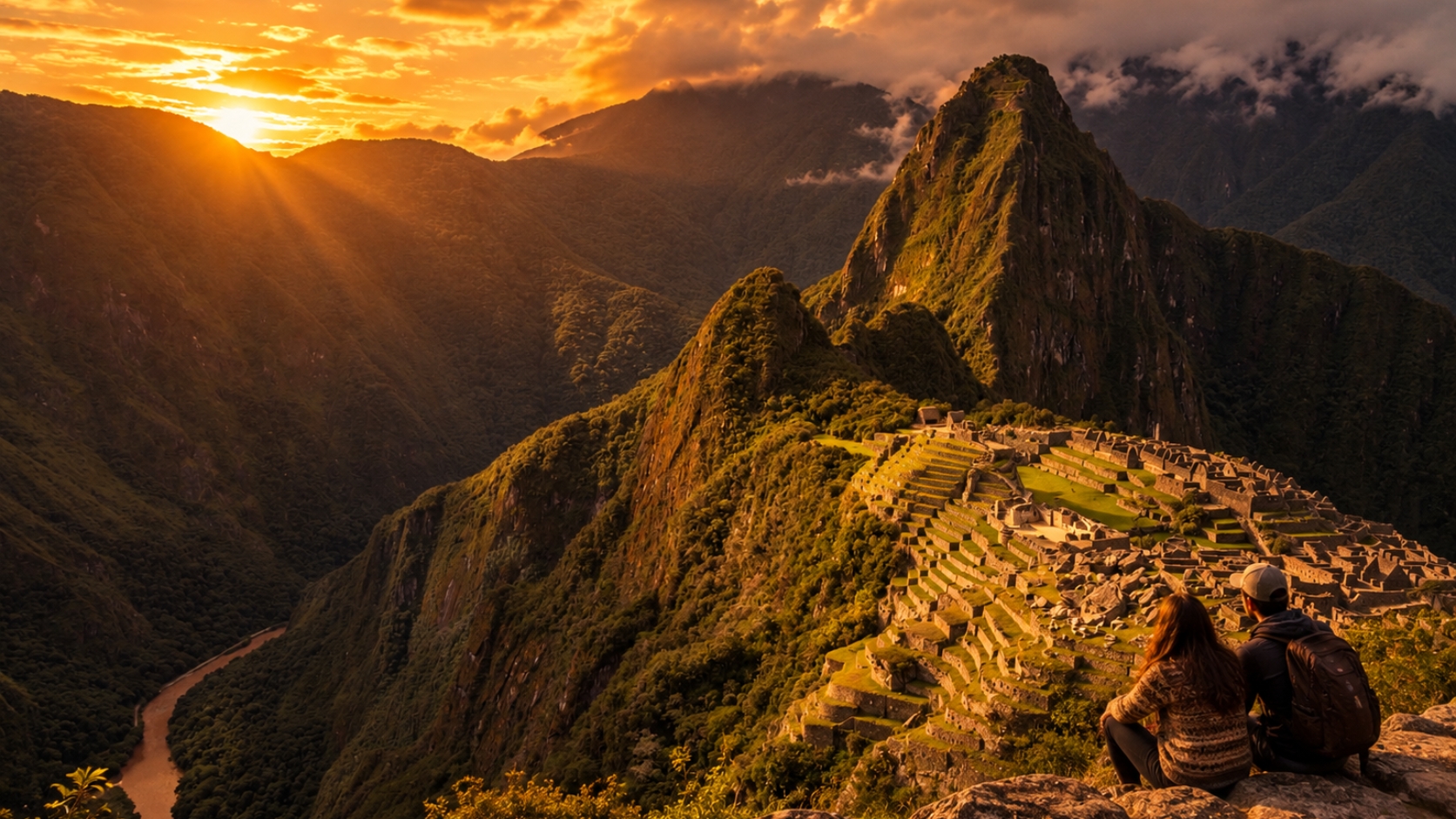
Our guide will take you to the most important sites and share with you the secrets and the architecture of this Lost City of the Incas. Divided into three areas, agricultural, urban, and religious, the structures are arranged so that the purpose of the building matches the surroundings. Nature, social purpose of the site and architecture live in perfect harmony. The agricultural terracing and aqueducts take advantage of the natural slopes; the lower areas contain buildings occupied by farmers and teachers, and the most important religious areas are located on the hilltop, overlooking the lush Urubamba Valley thousands of feet below. If you climb Huayna Picchu (not included) you will have a spectacular view of Machu Picchu from above. Alternatively, we suggest you climb the spectacular Machu Picchu Mountain (not included). In the afternoon, back to Aguas Calientes where you can take a well-deserved relaxing dip in the hot springs and then board the scenic train back to Ollantaytambo and transfer to your hotel in Cusco.
After breakfast, you may have time to visit the trendy district of San Blas, the Chocolate Museum and the many craft shops in Cusco. Then it is back to Lima by plane and a transfer to your hotel. (If you prefer we can arrange tours in Cusco if you decide to return to Lima a day later). Dinner in Lima at your hotel.

Depending on your flight schedule, we suggest a visit to the Pachacamac, Museo de Oro or a gastronomic tour before transfering from your hotel to the airport and fly back home.
No filters, no middlemen — with local operators in Lima, Cusco and Arequipa